
News & Updates
Epton Connections
For more information or to schedule an interview with our experts, please contact our Media Relations Department.
Email: [email protected]
Text: 0410 084 811
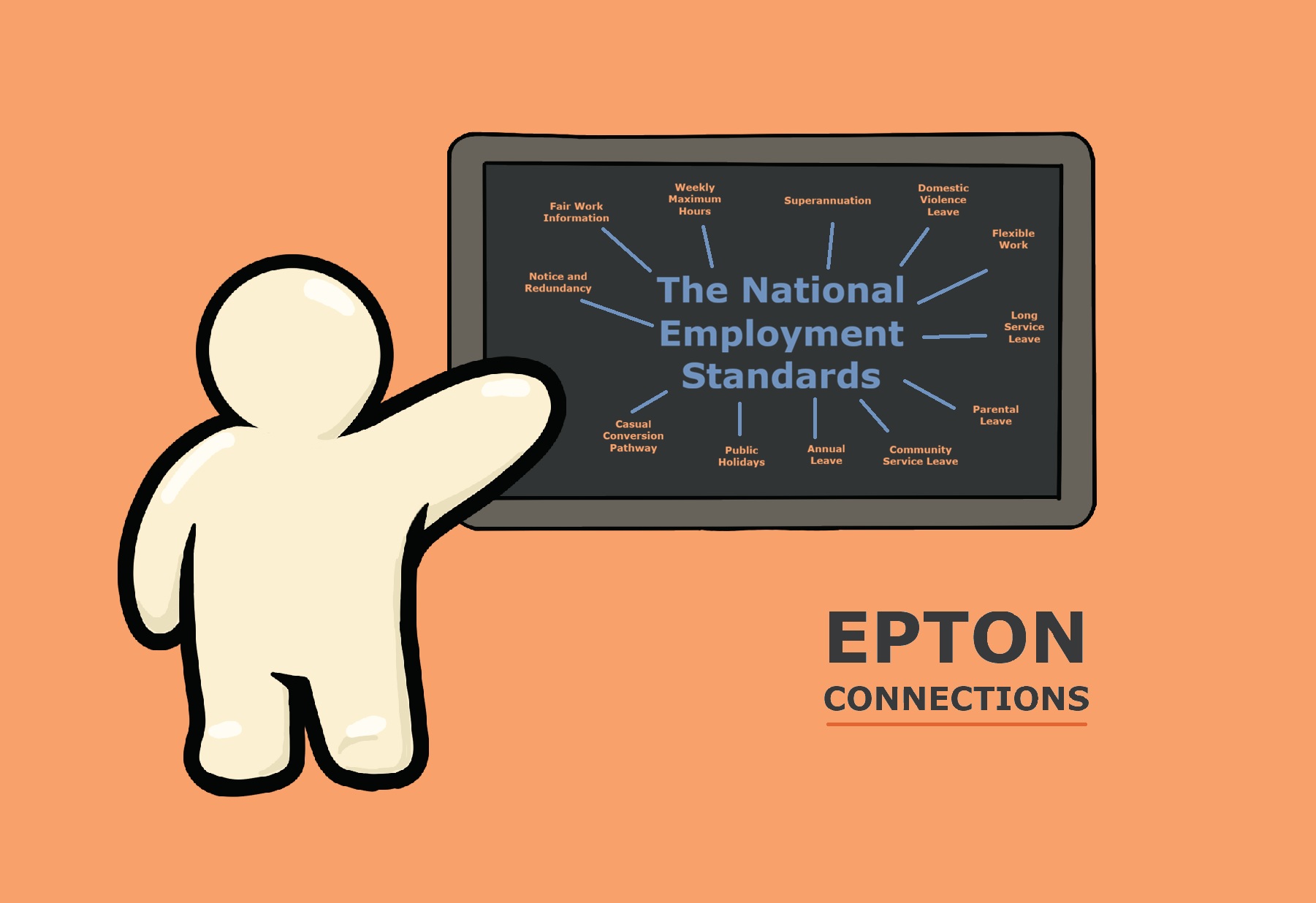
The National Employment Standards and what you need to know as an SME
As a micro or small business owner, you may not be familiar with the National Employment Standards (NES). However, once you have employed staff, these standards are essential. They set the minimum legal entitlements for employees in Australia and form part of the Fair Work Act 2009.
This guide breaks down each standard to help you understand how they apply in practice, and how they shape the way you engage and manage workers.
So... what are the National Employment Standards?
The NES are a set of minimum employment entitlements (or 'rights') for employees in Australia, introduced by the Austalian Government in 2010. Originally, 10 standards were accepted, which have since expanded, and now form the foundation of workplace rights in Australia. All employers, regardless of size, must comply with them.
Below, we explore each entitlement and what it means for your business.
Maximum weekly hours
Full‑time employees can work a maximum of 38 hours per week, while part‑time employees have a maximum based on their contracted hours (e.g., 15 hours per week).
Employees may work additional hours if requested, but only when those hours are reasonable. They can refuse unreasonable additional hours, of which refutable reasons are set out by the Fair Work Ombudsman.
Hours worked beyond maximum hours incur an over-time penalty.
An employer may also request an 'averaging agreement' where hours are spread out over a defined period of time, such as a month. This is only lawful, however, if there is a provision for hours averaging in the governing award or enterprise agreement, and if the employee consents to the agreement. An employer cannot force an employee into averaging arrangements.
Requests for flexible working arrangements
Flexible working arrangements are changes made to how, where or when the employee's work gets done. To qualify under the NES for flexible working arrangements, a full-time or part-time worker needs to have been working with an employer for over twelve months. Casual employeers must meet this criteria, and additionally expect to continue working with the employer on a 'regular and systematic' basis.
An employer must respond to requests for flexible working arrangements within twenty one days. An employer may only decline the request on genuine business grounds, and must demonstrate they have made genuine attempts to discuss the request with the employee, reach an alternative agreement, and considered the consequences for the employee should the request be denied.
Employee Choice about Casual Employment
The rules around casual employment have changed; casual employees now have a pathway to request permanent employment, should both the employee and the employer agree. An employee can make a request in writing as long as they have been employed for twelve months for small businesses, or six months for medium and large organisations. An employee can only refuse a request from the employee choice pathway under specific criteria, such as if the conversion would require significant changes to business operations.
Parental leave and related entitlements
Parental leave is an unpaid entitlement employees are eligible for once they have completed twelve months of continuous service with the same employer. This provision includes birth- and adoption-related leave, as well as circumstances such as stillbirth. Pregnant employees have the right to request a transfer to a safer job or take no safe job leave if required.
Each parent is eligible for twelve months unpaid parental leave and may request an extension for an additional twelve months.
These entitlements apply even if both parents work for the same employer.
Employees are guaranteed a return to their pre‑leave position or an equivalent role.
Annual leave
Annual leave is an minimum entitlement of four weeks of paid leave per year, as acrued by full-time employees. Part-time employees accrue annual leave pro rata (equivalent to how much FTE they work), and shift workers may accrue additional leave depending on their hours.
Each Award and Enterprise Agreement can differ based on the minimum set out within in them, but they cannot be less than four weeks per year. To understand the legal annual leave entitlement for employees in your business, you will need to refer to your specific industrial tool (i.e. Modern Award or Enterprise Agreement).
Employees can also negotiate a higher annual leave accrual under an Individual Agreement.
Annual leave, if not used within the year, rolls over to the following period; annual leave also accrues whilst the employee is on paid leave.
Personal/carer's leave, compassionate leave and family and domestic violence leave
Also known as sick leave or carer's leave, full-time employees are entitled to ten days of leave each year to help deal with personal illness, caring responsibilites or family emergencies. Part-time workers accrue this entitlement pro-rata, whilst casual workers do not accrue this entitlement. Any leave of this type that is not used rolls over each year.
Employees may additionally take bereavement leave, otherwise known as compassionate leave, for up to two days per occasion for the death or life‑threatening illness of an immediate family or household member. Employees may also take this leave type if a baby in their immediate family or house hold is stillborn, or the employee or the employee's spouse or de facto partner has a miscarriage.
Domestic and Family violence leave is available for all employees, including casuals, and equates to ten paid days of leave each year of employment. This leave type does not roll over.
Community service leave
An employee is entitled to take Community Service Leave; this is an unpaid leave type, and there is no longer a limit on how much time an employee can take away from work to volunteer in emergency management situations and for travel and rest time. There is an exception for jury duty, which is paid.
Long service leave
Employees are eligible for long service leave (LSL) when they have worked at an organisation for a long period of continuous service. LSL is regulated by each state and territory, so entitlements vary. Some industries also have portable LSL, where leave accrues across employers within the same industry (e.g., community services).
In New South Wales, an employee gain access to LSL once they have worked with an employer for 10 years continuously and continues to accrue beyond this point.
Public holidays
All employees are entitled to be absent from work on public holidays. Each state has different public holidays, so it is important for employers to check public holiday calendars. If the employee would normally be rostered on that day, they must be paid for their absence.
Different pay and entitlements may apply when employees work on public holidays.
Learn more at Not working on public holidays.
Superannuation contributions
Employers must pay superannuation contributions on top of an employee’s wages. At the time of writing this article, the superannuation contribution is twelve per cent of the employee's earnings (as long as the employee is eighteen or over, or under eighteen but works more than thirty hours per week), and frequently increases. As of 1 July 2026, superannuation contributions must be paid each pay period (regardless of whether that is weekly, fortnightly, or monthly).
Employers must also withhold and pay tax on behalf of employees, based on current ATO rates here.
Notice of termination and redundancy pay
Dismissal occurs when an employer ends the employment relationship with the employee, and can occur for a variety of reasons; redundancy, serious misconduct, escalated misconduct, or ongoing underperformance. When ending employment, employers must provide notice, unless the employee is being dismissed for serious misconduct or is a casual, maximum‑term or contract worker.
A notice period begins the day after the employer informs the employee that their employment is ending, and ends on their last day of employment. Any days not worked will need to be paid out in lieu of notice. A notice period generally ranges from one to four weeks based on the employee's length of service. Where the employee is over forty five years old, an additional week is added to the notice period if they have been employed with the employer for over two years.
The employer may wish for the employee to work out their notice period, pay them in lieu of the notice period, or a combination of both. Employees may request to finish earlier, but if agreement cannot be reached, they may resign and provide their own notice.
Whilst the NES has a minimum termination notice entitlement, Modern Awards, Enterprise Agreements and Individual Agreements may stipulate a longer period.
Notice of termination is separate to redundancy pay. If an employee is made redundant, they are also entitled to redundancy pay, which is calculated on the employee's length of service. More information on this can be found here.
Fair Work Information Statement (the FWIS) and Casual Employment Information Statement (the CEIS).
Employers have to give every new employee a copy of the Fair Work Information Statement (the FWIS) when they start their new job.
Employers also have to give every new casual employee a copy of the Casual Employment Information Statement (the CEIS) when they start employment, and at set times throughout their employment.
Legally, medium and large businesses must reissue the CEIS at 6 months, and all businesses must reissue it every 12 months while the employee remains casual.
Casual Employees and the NES
Casual employees are only entitled to some of the National Employment Standards; employee choice, paid family and domestic violence leave, unpaid carer's leave, unpaid compassionate leave, unpaid community service leave, the Fair Work Information Statement (the FWIS) and the Casual Employment Information Statement (the CEIS). Some casuals are also eligble for long service leave, flexible working arrangements and unpaid parental leave, depending on the state they work in and if they have worked regularly and systematically for twelve or more months, as well as reasonably expecting to still be employed by the employer on an ongoing basis.
Need help applying the NES in your business?
If you’re still unsure how these standards apply to your workplace, or you’d like support interpreting your award, contracts or obligations, I’m here to help. You can book a free 30‑minute discovery call with me to talk through your business context and get clear, practical guidance on your next steps.
References:
https://www.fairwork.gov.au/employment-conditions/national-employment-standards & various sites embedded within.

Frequently Asked Questions
At Epton Connections, we know it’s not always obvious what kind of people support your business needs. These FAQs are here to help you understand common challenges and how we can support you.
If you’re still unsure, you can book an obligation‑free discovery call using the “Book a Consultation” button and we’ll talk through your situation and point you in the right direction.
Question 1: I don’t have an HR department. Is Epton Connections right for me?
Yes. Most of our clients are small–medium businesses or community organisations without internal HR capability. We provide practical, on‑demand support so you can manage people issues confidently without needing a full-time HR hire.
Question 2: What kinds of people problems can you help with?
We support everything from performance conversations, conflict, and culture challenges to recruitment, onboarding, role clarity, policies, and leadership capability. If it involves people, we can help you navigate it.
Question 3: Do you offer once‑off advice, or ongoing support?
Both. Some clients come to us for a single issue; others engage us as their fractional People Partner for ongoing guidance, coaching, and capability building.
Question 4: I’m not sure what my business needs — where do I start?
Start with a discovery call. We’ll talk through what’s happening in your business, identify the root issues, and outline practical next steps. There’s no obligation and no jargon.
Question 5: Can you help with compliance and documentation?
Yes. We create or refine policies, contracts, role descriptions, and people frameworks that are compliant, practical, and tailored to your organisation.
Question 6: Do you work with not‑for‑profits and community organisations?
Absolutely. We have deep experience supporting NFPs, charities, and community-led organisations with people challenges, governance, and capability uplift.
Question 7: What makes Epton Connections different from other HR consultants?
Epton Connections combines strategic HR expertise with a human, grounded approach. You get clear advice, practical tools, and support that fits your business, not one‑size‑fits‑all solutions.
Question 8: Do you offer leadership or team development?
Yes. We design and deliver capability-building workshops, coaching, and tailored development programs for leaders and teams at all stages of growth.
Question 9: Can you help with recruitment?
Yes. We support role design, job ads, shortlisting, interview frameworks, and selection processes, ensuring you hire well and with confidence.
Question 10: What does a typical engagement cost?
Costs vary depending on the level of support you need. After a discovery call, we’ll provide a clear, transparent quote with no surprises.
People. Purpose. Connection.
Quick Links
Legal
Privacy Policy
Terms & Conditions
Connect


ABN 55 255 056 128
© 2026
All Rights Reserved